Context as a topology, not a session.
Scint is an agent workspace I designed and built on my own: a runtime, an MCP server, a process daemon and a native macOS app. Its central idea: you don't open a thread, you create a space. The space becomes the focal point of context. Its interactions split by intent into a hierarchy of transcripts that is the source of truth, and each request is classified by TypeSafe's Jev to decide which mapping over that record the agent sees. Spaces are hierarchical too, so delegated work becomes a sub-space that persists.
Role
Sole designer and engineer, from runtime to interface
Built
Runtime, MCP server, XPC process daemon, native app, design system
Models
TypeSafe Jev for routing; Claude Code and Codex for agent runs
Scale
About 17,000 lines of Swift across five modules
Threads get used until they stop working, then thrown away.
The usual way to work with an agent is to open a thread and keep using it until it stops working. A loop hands the model its message history, the model calls tools, and the history grows. Models get worse at using a long context well before the window is full, and the standard fix is compaction: summarize what came before and carry on. Summaries drop the subgoal that was in progress and the constraint that mattered. Eventually the thread is abandoned for a new one, and a sub-agent's work comes back as a paragraph from an agent you never see.
Scint replaces the thread with a space. You create a space instead of opening a thread, and it becomes the focal point of the context for that work. It keeps everything, splits what happens in it by intent, and gives each request a view chosen for the kind of work being asked for.
The space is the unit
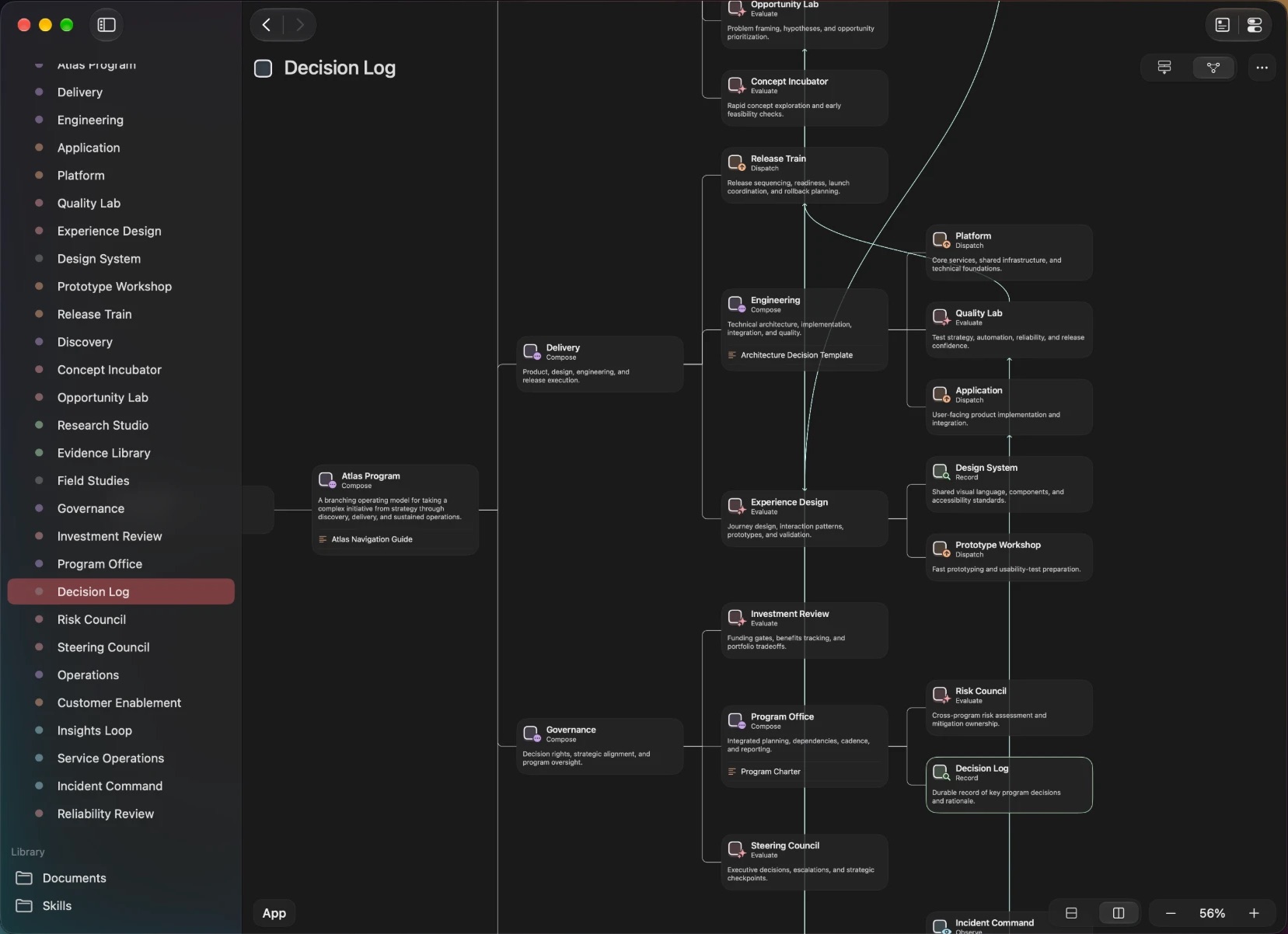
Work starts by creating a space, not a thread. The space holds the documents, commands and record for that work, and it stays.
Split by intent
The ongoing conversation stays in the space's root transcript. Each kind of agent work is split out into its own nested transcript.
Keep the whole record
Every request, reply, tool call, reasoning step and error is stored. The transcript hierarchy is the source of truth, and nothing is compacted.
Map, don't carry
Each request is classified, and the classification decides the mapping over that record the agent sees, so the last request starts as light as the first.
Delegate into places
When a space needs a sub-agent, it creates a sub-space with the same transcript pattern. Sub-spaces persist, and you can open them.
Refine the space over time
Documents, commands and links to other spaces can be assigned to a space directly or passed in through its input, so the space gets better at its work.
Two dimensions, one loop.
A thread has one axis: time, in a single history that grows until it is compacted. With the space as the focal point, context gets two. Spaces say where context lives, and they nest. Transcripts say what happened there, and they nest too. Neither is ever thrown away, and no request receives all of either.
Dimension one · Where
Spaces
The structure of the work. Each space is its own context, with its own documents, commands, provider, queue and transcript, and any space can run an agent. Spaces nest and link through bridges. When a space working in Compose needs a sub-agent, it creates a sub-space with the same transcript pattern, and that sub-space persists.
Dimension two · What happened
Transcripts
The history of the work. The ongoing conversation stays in the space's root transcript. An agent's work is split out by intent into nested transcripts holding its tool calls, reasoning and output. The hierarchy is the source of truth, and nothing is compacted.
Each request is classified, and its intent decides the mapping over both: the spaces it can see, from Compose's space, children and bridges down to Process's single space, and which transcripts it excerpts, with how much of each.
A request moves through the same five steps no matter where it came from.
- SubmitThe request is a document, placed in a space's queue.
- ClassifyJev reads it with the last few messages and picks an intent.
- MapCode builds the intent's view across the visible spaces and their transcripts.
- RunThe intent's method supplies a command. A model run starts fresh on the view.
- RecordOutput is parsed into Scint's own entries in that space's intent transcript.
- The next request is classified and mapped against spaces and records that now include this run.
One transcript per space, nested by intent.
A space's transcript is the source of truth. Requests and replies go into it, along with lifecycle signals for every run. Inside it, each intent keeps its own nested transcript: Compose, Process, Evaluate, Observe and Search. That is where each kind of work's invocations, tool calls, reasoning, output and errors build up.
A person reads one short conversation per space and never manages sessions or threads. The full working detail is one step away, attached to the conversation at the point where each run happened.
The split is what lets a space last. The conversation grows slowly, because agent work goes to the nested transcripts instead of piling into it. A space can stay in use far longer than a thread kept alive with compaction, and it stays the place where that work happens.
Transcript
structureView this space
structureCreate Atlas Program: 28 spaces in one call
structureView Delivery, Discovery, Governance, Operations
contentCreate 5 documents, among them Program Charter, Architecture Decision Template and Operational Readiness Checklist
structureBridge Evidence Library, Quality Lab, Release Train, Design System, Steering Council, Insights Loop, Incident Command, Risk Council
structureView every space again to verify it
Plus the agent's reasoning between calls.
One entry: the reply. Jev moved the space to Process, and a different provider answered than the one that built the project.
The runs that built this project spent about 18,000 tokens across 61 tool calls. The conversation they left behind is about 420. Nothing was summarized away: every call is still in the Compose transcript, whole, and reachable. The space's inspector shows the same split live, with an estimate of stored context, each intent's share and run count, tool calls and total run time.
A decision model splits the work.
Before any agent runs, Scint asks one question: which intent should handle this request? It sends the question to Jev, TypeSafe's decision model, which answers with a typed choice, a confidence and a probability for each option instead of prose. That one call decides which transcript the run works in, what the agent will see, and which command runs.
The state Jev decides on is structured data, not a prompt: the request, the last six messages of the conversation, and a routing guide that describes each intent by the work it does, what it sees, the requests it takes, what it is not, and examples. Jev can also choose none, for greetings, acknowledgements and small follow-ups, and the space keeps its current intent. A request can name its intent outright and skip the call. If the call fails, the space keeps its intent and the request runs anyway.
The kind of request each intent takes
Code, not a model, builds what the agent sees.
Once the intent is chosen, Scint builds the starting view entirely in code. No second model pass summarizes or curates memory. Each intent has its own mapping over the most recent context: which structure is visible, which commands and documents are listed, and how much of which transcripts is excerpted.
What an intent records and what it reads are separate choices. Observe keeps its own transcript, but its view draws on the shared conversation and Process's history. Compose sees broadly and shallowly; Process sees narrowly and deeply.
Listed in the request
History excerpted, in characters
- BaseWhat Scint is, how its links and tools work, and how to reply: one final message, no narration.
- IntentThe chosen intent's own instructions.
- SpaceCards for the structure this intent can see, each with a name, a live
scint://link and a description. - InterfacesThe commands, and for Compose the interfaces, the agent can inspect or invoke through MCP.
- ContentDocuments and files by name, link and description. Their contents are read through MCP, as they are at that moment.
- ThreadExcerpts in a fixed order: the shared conversation, then the Compose, Evaluate, Process and Search transcripts, each within its intent's budget.
- RequestThe message itself, rendered from its document.
The record is what happened. Documents are where the work stands.
The transcript and the documents give two different kinds of continuity. The transcript records experience; documents hold the current state of the work. A request combines both. Update a style guide, and the next request reads the new version while the conversation that led to the change stays exactly as it was.
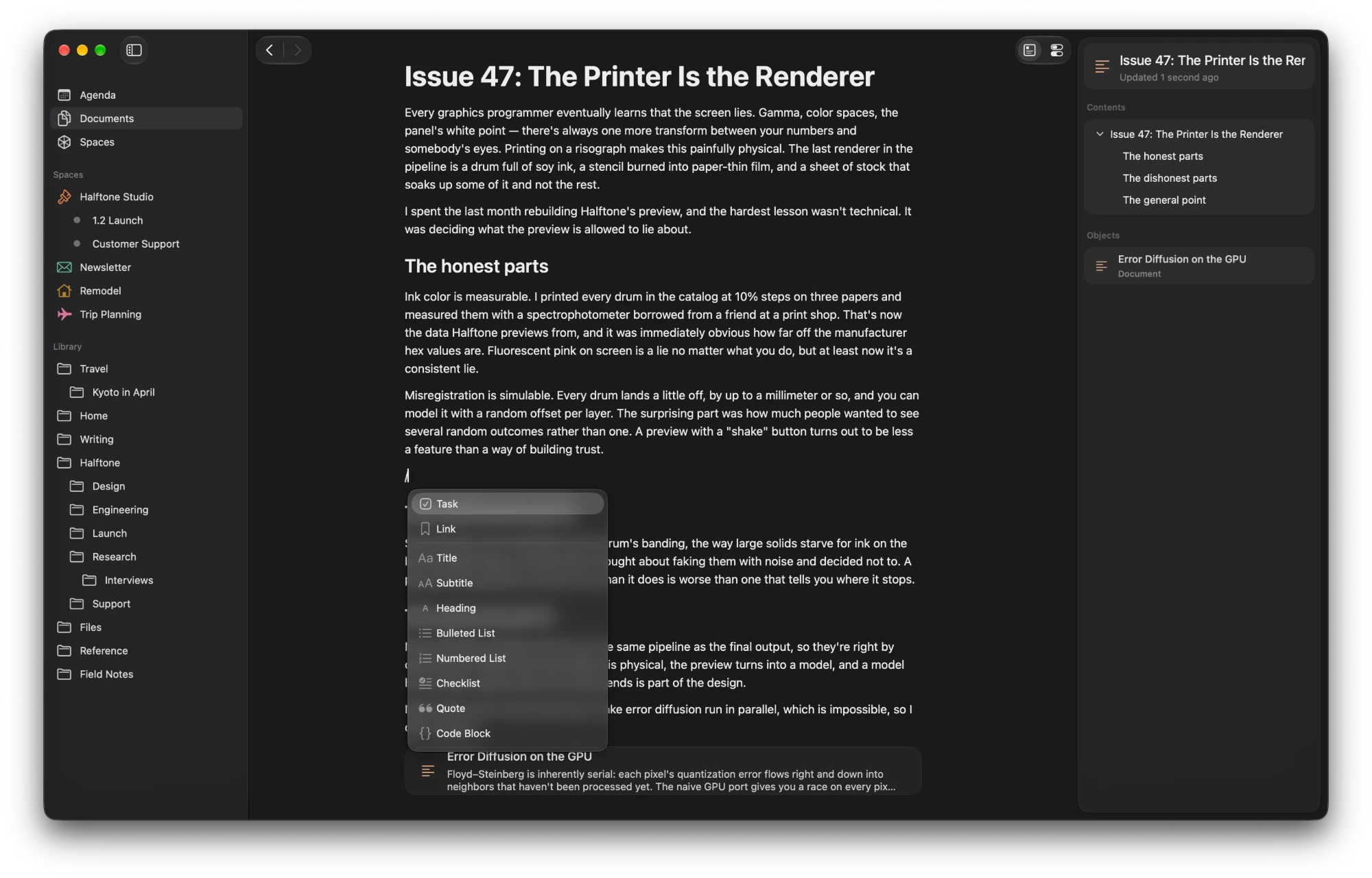
Every object in the runtime has one identity, and every relation is a reference to it. A document can sit in any number of folders and spaces and still be one document. It can embed other documents, files, links and commands by reference. When an agent edits a document someone has open, they watch it change, because there is no copy to sync. The architecture notes show this in action.
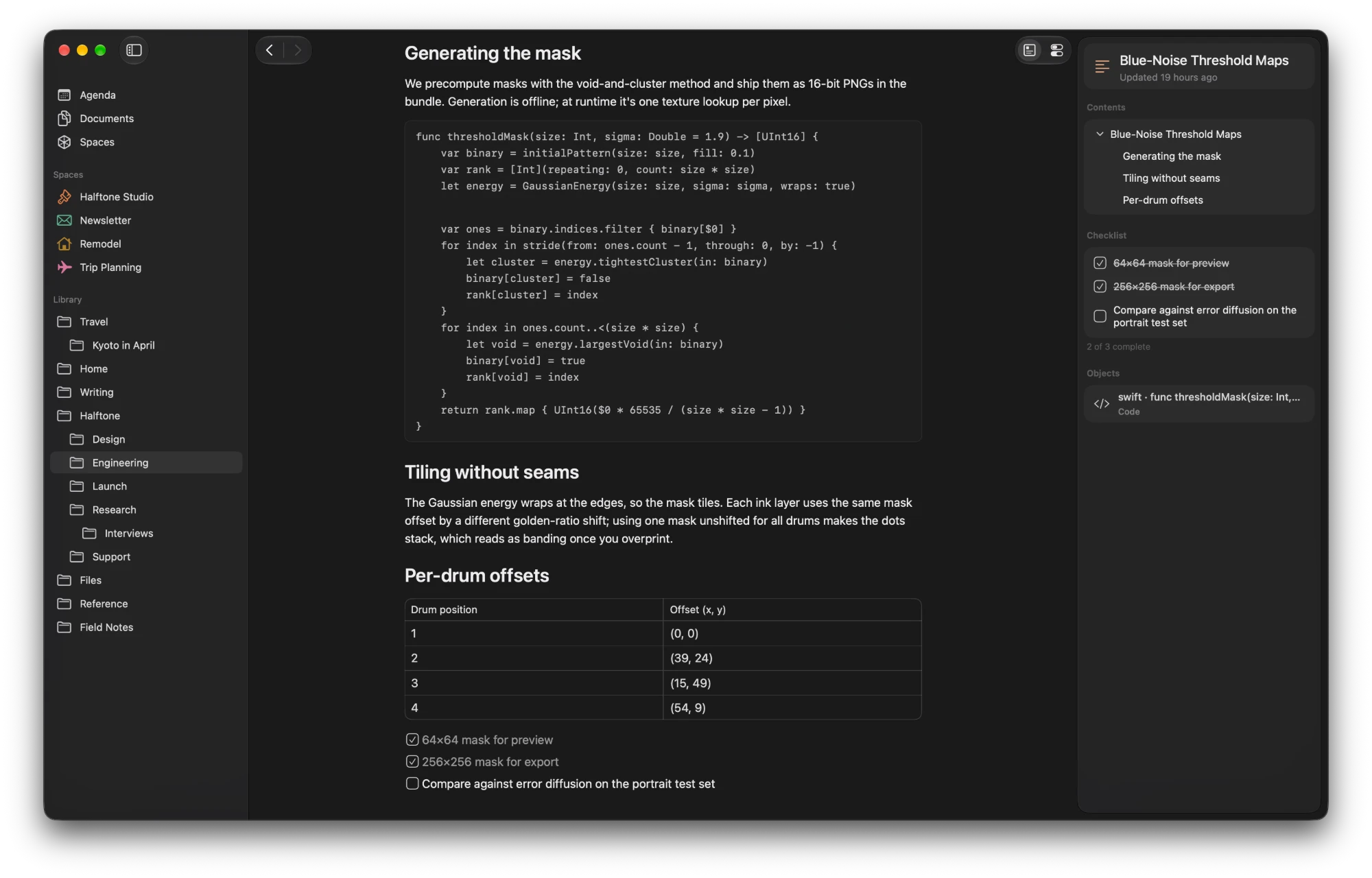
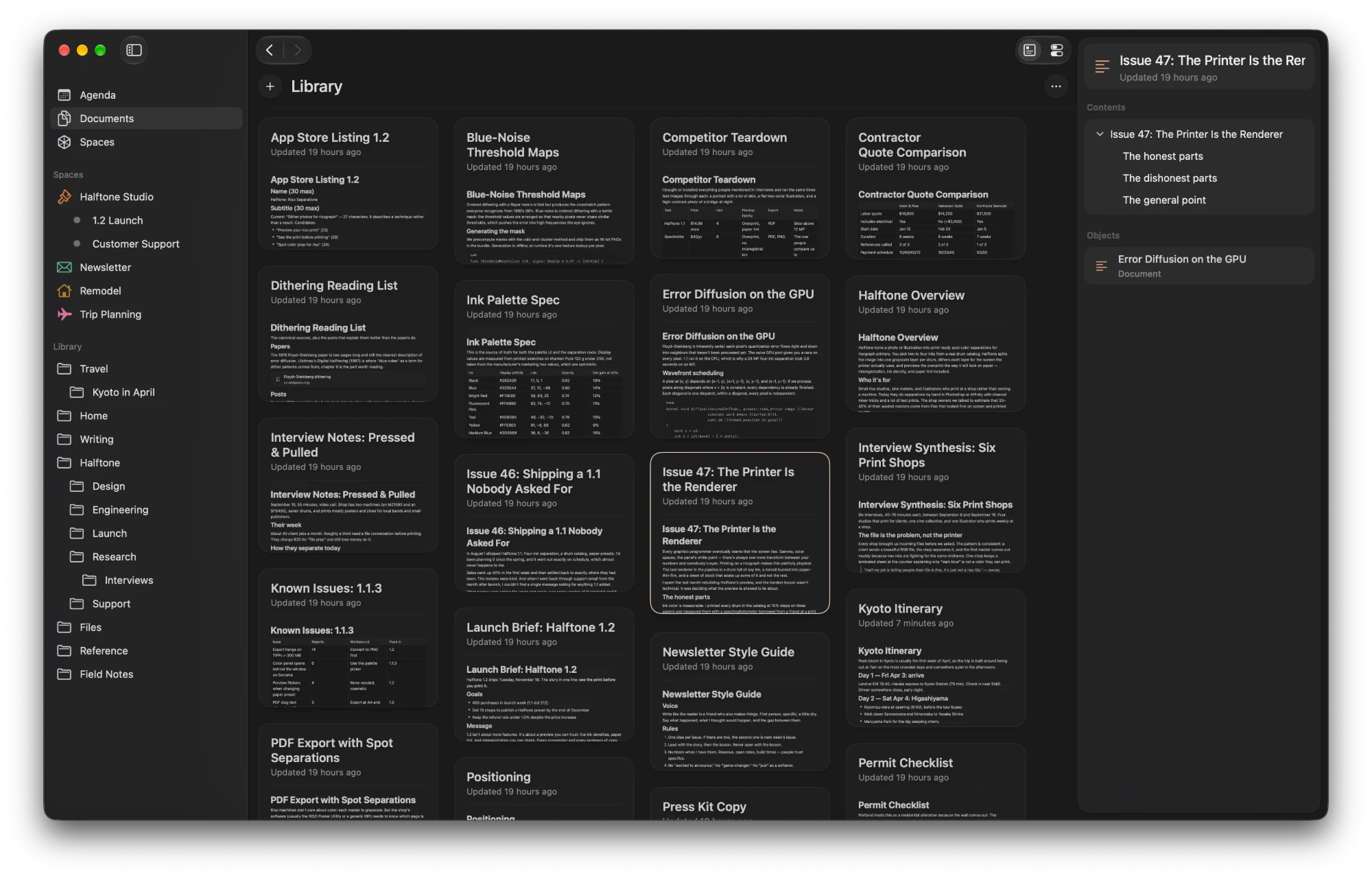
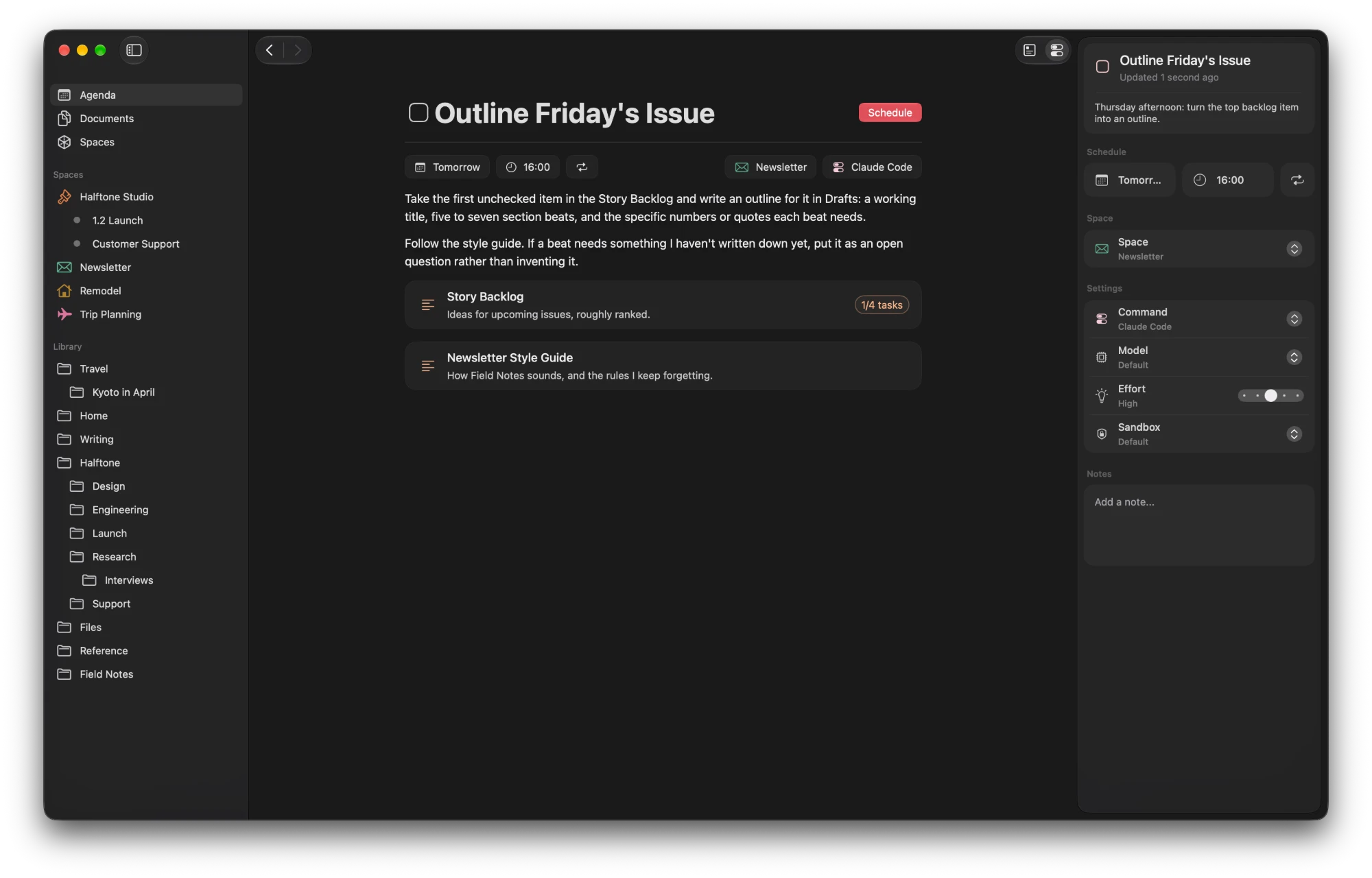
Every request is a document, and a space is refined through them.
The message box at the bottom of a space is the same block editor used for documents. Its body carries instructions and references; its header carries execution settings such as the command and its model and effort. When a message is sent, the space's queue prepares the next draft and carries those settings forward.
The same component system is how a space gets better at its work over time. Documents, commands, files and links to other spaces can be assigned to a space directly, so they become part of its context for every request whose mapping lists them. Or they can be passed in through the input, embedded in a single message for that run. Either way, the space is refined with the same blocks people write with every day.
Tasks are documents too. They live together in Agenda, and each has a schedule, the space it works in, and the command that runs it. A task does one thing: when it comes due, it dispatches to its space as a request, exactly like a message typed there. That space classifies and maps it against its own record and documents, and the run joins its transcript.
A message typed into a space, a task that comes due, one space briefing another, an MCP compose call and a scint:// callback URL from another app all arrive the same way: as a document submitted to a space. Every run is queued, recorded and handled by the same rules, whoever asked.
Delegation creates a place, not a summary.
Most harnesses create a sub-agent, collect its answer, and throw it away without ever showing it to you; the context it spent is gone. In Scint, spaces are hierarchical. When a space, usually one working in Compose, decides a sub-agent is needed, it creates a sub-space (a whole tree in one call if needed), briefs it and starts it. The sub-space uses the same transcript pattern: its own conversation, its own nested transcripts by intent, its own documents. It persists. You can open it, read what happened, and keep working in it.
Containment and bridges are two structures over the same spaces. Containment says where a space belongs; a bridge says which spaces work together, and it carries documents and commands of its own.
Intent, command and model are separate choices.
An intent picks a method on the space's interface, and the method supplies the command; a request can also name its own command. A model is just an argument to a command that uses one. Calling a model is one thing commands do: Observe's default command is the scheduler, not a model.
A command is an executable with a typed argument list. From that one definition, Scint derives the command line, the MCP tool schema for the space's agent, and the controls in the inspector. That holds for the provider commands and for any command added later. Claude Code's and Codex's streaming output is translated into the same set of entries (output, reasoning, tool calls, errors), so the record belongs to Scint rather than to whichever model wrote it, and providers can change between two requests.
// Abbreviated from the seeded Claude Code command
Command.new(
    name: "Claude Code",
    artifact: artifacts.claude,
    args: [
        .command("--print"),
        .command("--output-format"), .command("stream-json"),
        .command("--mcp-config"), .command(claudeConfig),
        .options("--model", ["claude-fable-5-1", "claude-opus-5", …]),
        .reference("--add-dir=", .typeId(Artifact.self)),
        .range("--effort", ["low", "medium", "high", "xhigh", "max"]),
        .options("--permission-mode", ["default", "acceptEdits", …], value: "default"),
        .text("input", required: true)
    ]
)
# Values come from the request document's header; input is the mapped view
claude --print --output-format stream-json --verbose \
  --mcp-config '{"mcpServers":{"scint":{"type":"http", … "Bearer ${SCINT_CONTEXT}"}}}' \
  --strict-mcp-config --model claude-opus-5 --effort high \
  --permission-mode default "<the mapped request>"
{
  "type": "object",
  "properties": {
    "--model": { "type": "string", "enum": ["claude-fable-5-1", "claude-opus-5", …] },
    "--add-dir=": { "type": "string", "format": "uri", "description": "A scint:// link." },
    "--effort": { "type": "string", "enum": ["low", "medium", "high", "xhigh", "max"] },
    "--permission-mode": { "type": "string", "enum": ["default", "acceptEdits", …] },
    "input": { "type": "string" }
  },
  "required": ["input"]
}
scint:// links.The systems work underneath.
MCP server
An HTTP MCP server on localhost with built-in tools for structure, content, compose and search, plus a tool for every command attached to the calling space. An agent authenticates with its space's context id, so its command tools are its own space's.
Process daemon
scintd, an XPC service registered through SMAppService, runs commands with the user's login-shell environment, streams output, and supervises long-running services with never, on-failure and always restart policies.
Identity and search
A reference graph where every object carries five identifiers (object, type, descriptor, context and storage), a catalog that names and searches everything, and scint:// links that leave the app and come back as the same object.
Persistence and callbacks
Plain JSON under ~/.local/share/scint with batched, atomic writes. Every built-in tool is also an x-callback URL, parsed against the same schema MCP uses, so Shortcuts and other apps can drive the same operations.
What the design costs, and why it's worth it.
- Storage instead of summaries. The record grows without bound. Disk is cheap and the view is bounded, so the cost lands where it hurts least, and nothing has to be guessed away.
- Excerpts can miss older detail. Anything outside a view is still one tool call away: the agent can read any transcript or document through MCP by its link.
- A decision on every request. Routing adds one network call before each run. It is a fast, typed classification rather than an agent turn, and a failure leaves the space's intent in place, so the request still runs.
- No memory on the provider side. Codex runs ephemeral and every provider run starts fresh. Continuity is Scint's job, which is exactly what makes switching providers free.
I build the parts of agent systems that decide what a model sees.
- Context engineering: keeping a full record and mapping bounded, task-shaped views over it.
- Decision models in production: TypeSafe Jev routing every request, with structured state and criteria.
- MCP and tooling: a server, built-in tools, and tool schemas derived from typed command definitions.
- Orchestration: agents in many spaces, delegating through one queued path.
- Systems and product: a process daemon, persistence and identity layers, and the interface on top of them.
Scint is in development and designed and built by one person, Tim Kaechle. I'm available for work on LLM and agent systems: context engineering, decision-model routing, MCP integrations and full-stack products with agents at their core.